Today we're launching the biggest release in our company's history. It's a new set of agentic workflows built around one idea: AI should give the reps more freedom without sacrificing standardization and consistency leaders want. Here's how we got here, and what's new.
Nikola Mijic
-
October 21, 2026
-
5 mins
From automation to agents
When we started Matik in 2019, the job was automation. Admins owned rule-based templates and data definitions, and teams at Okta, Asana, Reddit, Samsara, Hinge Health and Handshake generated millions of accurate, on-brand narratives. But admin resources keep getting scarcer, and maintaining every template by hand no longer scales.
AI made automation table stakes. Reps can now build their own narratives in minutes, which creates a chicken-and-egg problem. Leaders want standardization so the playbook scales; reps want autonomy because the context that resonates with customers lives in their heads. Until now, you had to pick one.
What we kept hearing
Many teams tried to close that gap by pointing a general-purpose LLM at their decks. Over the past year, we heard the same two complaints again and again:
"I can't get the AI to give me a consistent output every time." The same prompt produces a different deck on Tuesday than it did on Monday. Numbers drift, slides go off brand, and nobody can trust what goes in front of a customer. And with no way to audit or track what the AI changed, there's no record of why a deck says what it says.
"Once the deck is generated, I have zero visibility." Reps edit, add and delete slides after generation. Leaders never see what changed, so the template never learns from the field and slowly goes stale.
The lesson was clear. Teams need decks they can trust, with deterministic outputs, accurate live data and on-brand design, plus the context only reps have. And the system has to keep itself fresh.
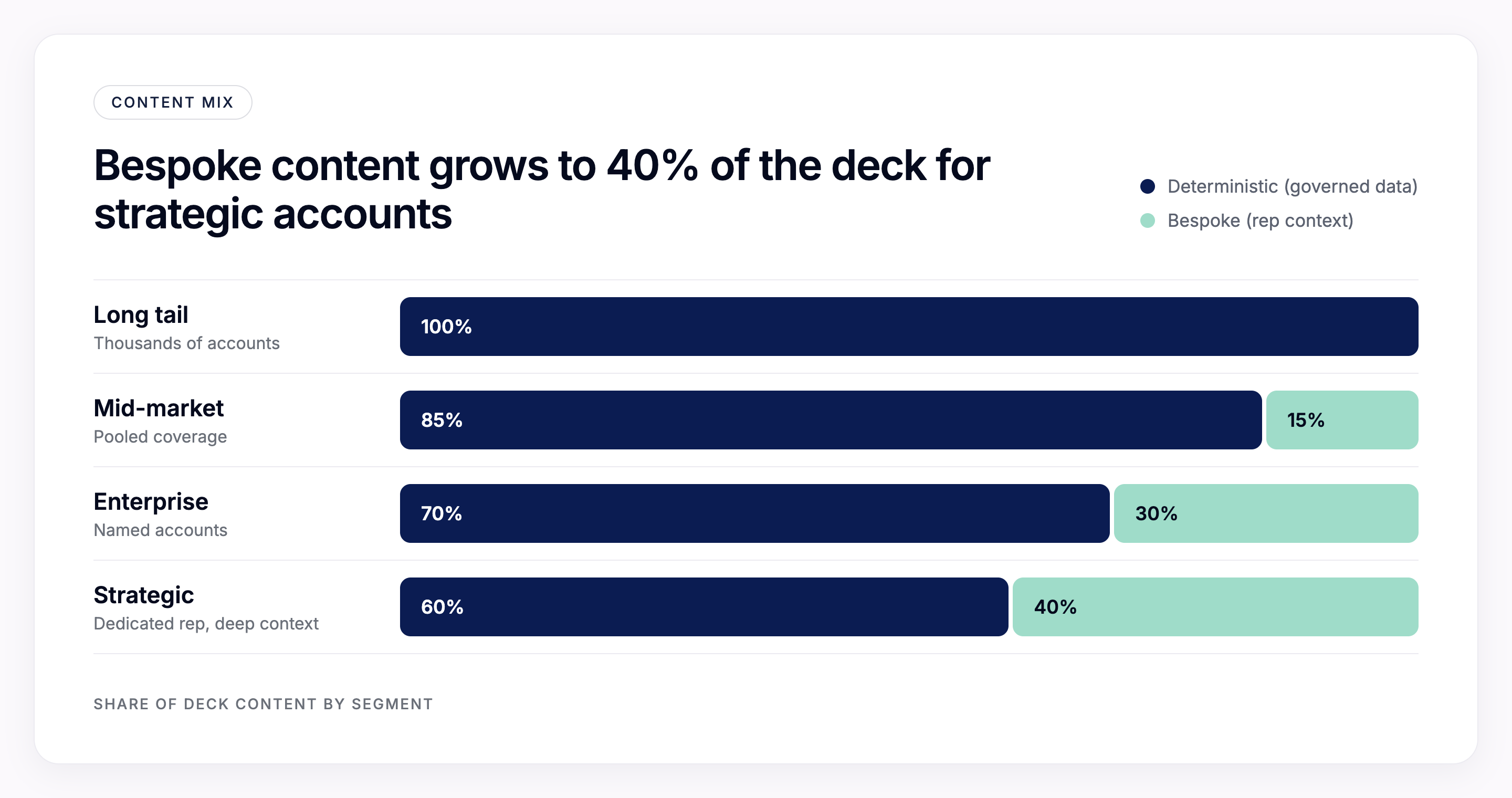
How much of a deck should be deterministic depends on who it's for. In the long tail, think SMB and high-volume renewals, teams send thousands of decks. Those outputs should be highly deterministic: the same template, the same metric definitions, every time.
At the other end, strategic accounts get fewer, higher-stakes decks. There, you still rely on determinism, however, given the size of accounts more bespoke elements will be infused.
Introducing Matik.ai
We are now solving both problems with a series of agentic workflows. Admins still own the foundation: the data, the templates and the guardrails. Agents work inside those guardrails to give reps freedom, and they report back what the field is doing so the playbook keeps improving.
Agentic workflows
We've launched a set of agents that each handle a different task in the content creation workflow, all working inside the guardrails admins set:
Admin Agent: Supports admins across the whole template lifecycle, from onboarding a new template (creating dynamic content, tagging and more) to troubleshooting and fixing errors, so admins spend less time on manual upkeep.
Narrative Agent: at a template level, Admins can give instructions that will execute upon generation. These instructions reference your context and data, so it can edit existing slides or create new ones on the fly for each generation.
End User Agent: A rep tells the agent their goal for a client conversation, and the agent finds the right template or collection of slides by searching across every template the rep can access. In addition users can add their own prompts and context to edit slides that have been created or add bespoke slides upon generation.
QA Agent: Checks each deck before it goes out, so the output stays accurate, consistent and on brand.
Context: your best practices, through MCP
Agents are only as good as the context they have access to. With MCP connections, Matik plugs into the tools where your team's knowledge already lives, from call recordings to CRM notes to your own best-practice playbooks. If the latest Gong call raised adoption concerns, the agent suggests a slide that addresses the recovery plan and the recommended next step. Reps get the context only they used to have, and leaders get it delivered in the format they approved.
Feedback Loops
Feedback Loops give leaders and admins the visibility they've been missing. Matik analyzes what reps change after a deck is generated, whether they edit it directly in Google Slides or prompt changes within Matik, and turns those patterns into concrete recommendations. For example:
22 of 46 analyzed decks added the same "AI Insights" library slide, so make it an optional part of the template.
31 of 46 decks overwrote the "active seats" number by hand, so automate it from the Snowflake usage table.
15 of 46 decks added a bar chart of tickets resolved over time, consider adding this to slide 6
Each recommendation shows how many decks and users it's based on, along with a confidence level. Admins can dismiss it, mark it done, or hand it to the Admin Agent to make the change. The template gets better every week, informed by the people closest to the customer.
Scale: mass creation and distribution
Not every deck needs a rep in the loop. Customers kept telling us they wanted to bulk generate customer-specific content and send it directly to their own customers. We have revamped our bulk generation processes to enable massive scale, while maintaining visibility and oversight. Easily generate personalized decks for an entire book of business in one run, each built from that account's live data, and deliver them automatically.
Generation can run on a schedule, like every quarter, or be triggered by a change in the data. For example, when an account's renewal is coming up in the next 90 days, Matik builds the renewal deck and sends it without anyone lifting a finger. That's what makes the long tail work: thousands of accounts get a timely, data-rich personalized story, while reps focus on the strategic accounts that need a bespoke touch.
See it in action
Control and autonomy, together
For years, the choice was rigid templates the field ignored, or freeform AI decks leaders couldn't trust. Matik removes that trade-off. Admins set the guardrails, reps bring the context, and Feedback Loops keep the two in sync.
The new Matik is available today. Request a demo to see how it works with your data and your playbook.
Join Our Newsletter
Don’t miss our next blog post & other great content!
From automation to agents
When we started Matik in 2019, the job was automation. Admins owned rule-based templates and data definitions, and teams at Okta, Asana, Reddit, Samsara, Hinge Health and Handshake generated millions of accurate, on-brand narratives. But admin resources keep getting scarcer, and maintaining every template by hand no longer scales.
AI made automation table stakes. Reps can now build their own narratives in minutes, which creates a chicken-and-egg problem. Leaders want standardization so the playbook scales; reps want autonomy because the context that resonates with customers lives in their heads. Until now, you had to pick one.
What we kept hearing
Many teams tried to close that gap by pointing a general-purpose LLM at their decks. Over the past year, we heard the same two complaints again and again:
"I can't get the AI to give me a consistent output every time." The same prompt produces a different deck on Tuesday than it did on Monday. Numbers drift, slides go off brand, and nobody can trust what goes in front of a customer. And with no way to audit or track what the AI changed, there's no record of why a deck says what it says.
"Once the deck is generated, I have zero visibility." Reps edit, add and delete slides after generation. Leaders never see what changed, so the template never learns from the field and slowly goes stale.
The lesson was clear. Teams need decks they can trust, with deterministic outputs, accurate live data and on-brand design, plus the context only reps have. And the system has to keep itself fresh.
How much of a deck should be deterministic depends on who it's for. In the long tail, think SMB and high-volume renewals, teams send thousands of decks. Those outputs should be highly deterministic: the same template, the same metric definitions, every time.
At the other end, strategic accounts get fewer, higher-stakes decks. There, you still rely on determinism, however, given the size of accounts more bespoke elements will be infused.
Introducing Matik.ai
We are now solving both problems with a series of agentic workflows. Admins still own the foundation: the data, the templates and the guardrails. Agents work inside those guardrails to give reps freedom, and they report back what the field is doing so the playbook keeps improving.
Agentic workflows
We've launched a set of agents that each handle a different task in the content creation workflow, all working inside the guardrails admins set:
Admin Agent: Supports admins across the whole template lifecycle, from onboarding a new template (creating dynamic content, tagging and more) to troubleshooting and fixing errors, so admins spend less time on manual upkeep.
Narrative Agent: at a template level, Admins can give instructions that will execute upon generation. These instructions reference your context and data, so it can edit existing slides or create new ones on the fly for each generation.
End User Agent: A rep tells the agent their goal for a client conversation, and the agent finds the right template or collection of slides by searching across every template the rep can access. In addition users can add their own prompts and context to edit slides that have been created or add bespoke slides upon generation.
QA Agent: Checks each deck before it goes out, so the output stays accurate, consistent and on brand.
Context: your best practices, through MCP
Agents are only as good as the context they have access to. With MCP connections, Matik plugs into the tools where your team's knowledge already lives, from call recordings to CRM notes to your own best-practice playbooks. If the latest Gong call raised adoption concerns, the agent suggests a slide that addresses the recovery plan and the recommended next step. Reps get the context only they used to have, and leaders get it delivered in the format they approved.
Feedback Loops
Feedback Loops give leaders and admins the visibility they've been missing. Matik analyzes what reps change after a deck is generated, whether they edit it directly in Google Slides or prompt changes within Matik, and turns those patterns into concrete recommendations. For example:
22 of 46 analyzed decks added the same "AI Insights" library slide, so make it an optional part of the template.
31 of 46 decks overwrote the "active seats" number by hand, so automate it from the Snowflake usage table.
15 of 46 decks added a bar chart of tickets resolved over time, consider adding this to slide 6
Each recommendation shows how many decks and users it's based on, along with a confidence level. Admins can dismiss it, mark it done, or hand it to the Admin Agent to make the change. The template gets better every week, informed by the people closest to the customer.
Scale: mass creation and distribution
Not every deck needs a rep in the loop. Customers kept telling us they wanted to bulk generate customer-specific content and send it directly to their own customers. We have revamped our bulk generation processes to enable massive scale, while maintaining visibility and oversight. Easily generate personalized decks for an entire book of business in one run, each built from that account's live data, and deliver them automatically.
Generation can run on a schedule, like every quarter, or be triggered by a change in the data. For example, when an account's renewal is coming up in the next 90 days, Matik builds the renewal deck and sends it without anyone lifting a finger. That's what makes the long tail work: thousands of accounts get a timely, data-rich personalized story, while reps focus on the strategic accounts that need a bespoke touch.
See it in action
Control and autonomy, together
For years, the choice was rigid templates the field ignored, or freeform AI decks leaders couldn't trust. Matik removes that trade-off. Admins set the guardrails, reps bring the context, and Feedback Loops keep the two in sync.
The new Matik is available today. Request a demo to see how it works with your data and your playbook.
Effectively communicate with colleagues, prospects, and customers using data and drive better decisions. Download one of our many templates to get started.