Download the ebook, How to Use Data to Build Customer Trust, to learn about the key factors that play into building customer trust throughout the customer journey, and how to effectively use data to build that trust—even during tough times.
Your copy is on the way to your email!
Oops! Something went wrong while submitting the form.
Introduction
When the economy is unstable, like with the economic downturn in 2022, businesses tend to become more conservative in their spending decisions. In times like these, it can be especially challenging for SaaS companies to win new customers, making customer retention more crucial than ever.
Retention is much more cost-effective than acquisition—in fact, according to Profitwell, acquisition can cost up to five times more than retention. Retention also has a greater ROI, and even just a small increase in retention rates can greatly impact a company’s profit. In the midst of an unsteady economy, SaaS teams must reevaluate their strategies and focus on what’s most important: fostering relationships with customers.
Customer retention is essential for business success, and in order to retain customers year after year, you have to make sure your customers trust you.
However, customer trust is a multi-faceted concept and can’t be achieved overnight. In this eBook, you’ll learn about the key factors that play into building customer trust throughout the customer journey, and how to effectively use data to build that trust—even during tough times.
Trust: The cornerstone of customer retention
According to Edelman's Trust Barometer, customers weigh two key factors when deciding whether or not to purchase a product: the price of the product, and whether or not they trust the brand. In fact, a survey conducted by Edelman revealed that 75% of respondents will buy from a brand they trust even if it’s not the cheapest option available. This research shows that brand trustworthiness can matter more to customers than the price of your product or services, especially in a competitive market.
Customers weigh these factors most when making a purchase decision:
Price of the product
Trust in the brand
Customer success teams are key ambassadors of the brand, and therefore they are a channel for cultivating brand trust. In order for them to build the trust and credibility customers need to continue buying a product, customer success teams must be able to prove the value of their product time and time again, especially during times of economic uncertainty. When done the right way, building trust goes far beyond just the renewal period—it needs to be woven into every part of the customer journey.
The customer journey
The ultimate goal of customer success is to support the customer at each stage in their journey while guiding them forward. Key stages in the customer lifestyle are:
Contract Start This is the traditional start of the relationship between customer success and the customer. While customer success may sometimes support sales prior to this point, from here on out, the responsibility lies with customer success.
Onboarding The onboarding stage marks a turning point in the customer journey. Rather than convincing a customer to buy your product or services, you are now focused on delivering a high-quality product and helping set them up for success with the product.
Adoption Beyond onboarding, the adoption stage is when a customer actually starts using and implementing your product into their workflow. In order to ensure the customer is engaging with the product, you will need to monitor their usage and ensure they are getting the most out of your product
Renewal In order to stick with your product during the renewal stage, customers must be reminded of the success they’ve seen with your product. It’s your responsibility to prove why your product is business critical.
Expansion Once your customer trusts you and has seen value in your product, they may decide they need even more out of it. This grants you the opportunity to expand their account in a way that is mutually beneficial.
Incorporating data-driven content
Since the entire customer journey presents opportunities to build trust with customers, it’s important to use the right data at each stage of the game. But data by itself is not enough—you must help your customers understand the actual insights revealed by the data. These insights help customers understand the value of your product, while the data gives them confidence in what they are seeing.
Data-driven content, which transforms raw data into easy-to-understand insights, is a critical tool for cultivating trust. Creating successful data-driven content requires a deep understanding of your customers. In order to craft narratives that will resonate with them, you need to understand their mission, objectives, and goals. Based on these objectives, you can collect data that matters to them and use it to tell a story.
Matik’s Hierarchy of Data
We’ve established that data-driven content is an important part of building trust with customers. But where should you begin when creating a logical strategy for data-driven content that works effectively and efficiently for your own team and customers? A great place to start is with the “Matik’s Hierarchy of Data” framework.
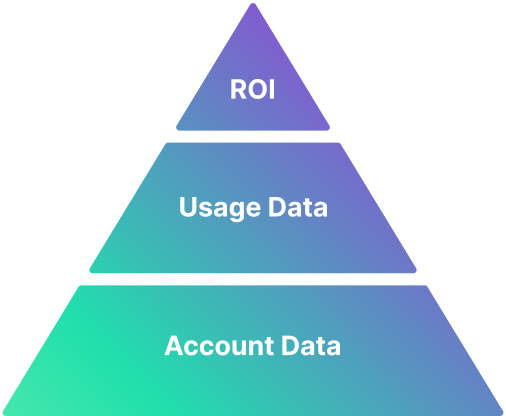
Similar to Maslow’s Hierarchy of Needs, as you go up the pyramid, the more “transcendent” the data and insights become. In the Matik pyramid, the bottom level is account data, the middle level is usage data, and the top of the pyramid is ROI data. Each of these pieces build upon each other. With account and usage data on the bottom levels of the pyramid at the beginning of the customer journey, you can build a solid foundation and work toward the pinnacle of the pyramid, which is measuring ROI data. This framework will help you build trust with customers at all stages.
Matik’s Hierarchy of Data
The top of the pyramid isn’t necessarily the most important type of data at all stages, but rather the ultimate data goal. By working your way up to ROI data gradually throughout the customer journey, you can make sure all the necessary pieces are in place. While ROI data is the end goal, it’s ideally presented during the renewal stage, and it can’t be delivered as effectively without focusing on the levels below it first.
What data should you use, and at which points in the customer journey?
Contract Start
Onboarding Share data on key objectives and goals; an overview of what has been purchased; as well as account and timeline data to show a clear path toward achievement.
Adoption Share usage data and feature adoption data (at the user level and the account level) to give an overview of the customer’s progress and how they’ve implemented the product so far.
Renewal Revisit the customer’s original objectives and shift toward ROI data during this stage to demonstrate how your product has helped the customer achieve their specific goals.
Expansion Share benchmarking data that reinforces the value of investing in additional services or features.
Key components of data-driven content
The customer-centric nature of data-driven content makes your customers feel like more than a revenue target and positions you as an advisor instead of a seller, which in turn builds trust and loyalty. Here are some key components of data-driven content:
Keep your customer in mind This is obvious, but so important it's worth restating. Once you start to learn information about a specific customer, such as their goals and product usage, use data to craft a personalized story and show that your product is delivering on your value proposition.
Narratives should build upon one another When sharing data throughout the customer journey, make sure to keep the larger story in mind, which is overall ROI and product value. Share data that reinforces this main story throughout the customer journey, from onboarding all the way through to renewal and expansion.
Get external and internal feedback Feedback from your accounts is important, but feedback from colleagues is also valuable. Are your other team members sharing information that is resonating with their customers, and can you incorporate that into your own content? What are marketing and sales teams learning in their interactions with prospects, and how can you carry this insight over to your customers?
How to get started
By now, you recognize the importance of data-driven stories and content when working to build customer trust. However, compiling data in a digestible format can often present some challenges—data silos, limited bandwidth, and other factors can stand in the way of telling consistent, compelling stories with data. To start, try following these steps:
01Create journey map Map out each stage in your customer journey so it's easier to determine what matters most to each customer depending on what stage they're in. For example, your stages may be discovery, negotiation, onboarding, adoption, renewal, and expansion.
02Develop the story Focus on the customer’s goals and objectives so you can determine which story you want to tell. The focal point of any data-driven content is how your product is in alignment with the customer and what they are trying to achieve.
03Choose data points Decide which data points will help tell your story depending on the stage in the customer journey. The data should build on itself throughout the customer journey (just like in Matik’s Hierarchy of Data).
04Scale In order to fully experience the impact of data-driven storytelling, the process needs to be scalable. Consider automating all or part of the process, creating templates, or making data more accessible to your CS team.
Trust is the key to customer retention, especially during uncertain times.
In order to establish trust with your customers, your team must be ready and willing to go the extra mile to share the value of your product and how it helps your customer achieve their goals. By customizing every touchpoint with data-driven content, your team will become a trusted partner that is able to support customers at every stage of the journey.
Loyal customers turn into brand advocates and evangelists.
The most powerful data-driven stories are not the ones that you tell about your company, but the ones that your customers tell about you. When you have consistently demonstrated the value of your product and created a relationship grounded in data-driven trust, your customers will not only continue to purchase your product, but they will also generate referral business and validate your reputation as a trustworthy brand.
Data-driven content in action
So, what kind of tangible impact can data-driven content actually have on your organization once it’s implemented in every stage of the customer journey?
We talked with representatives from five SaaS companies who have seen the benefits of data-driven content firsthand. Read on to get their insights.
Asana Nick Mangum, Head of Insights
What kinds of data-driven content do you create? “We create data-driven content for our Sales and Customer Success stakeholders so that they can have more valuable and data rich conversations with their clients. This includes business reviews, monthly check-ins, and a variety of other ‘choose your own adventure’ slides with data that can help to support client decisions. This content takes a variety of shapes—they could be charts, tables, numbers, logos, or even dynamic text that updates based on a variety of conditions. Matik allows us to be flexible and intelligent so that we're telling a cohesive story.”
Why do you use data in the content you share with customers? “Data makes stories come to life and feel relevant to customer conversations. Without it, you could be talking in hypotheticals or going through someone else's situation, and we want our customers to be informed about their performance, the trends we're seeing, and how to take specific actions as a result. This is what makes data-driven insights so important—they tell a story and keep our customers engaged in the content.”
How has data-driven content impacted your relationship/the way you work with customers? “Data-driven content allows us to be consultative and strategic with our customers so they get the best experience with our account team and our product. Internally, Matik has reduced manual reporting and given time back to help more of our customers. It also reduces the guesswork of how to produce the content or where to get the data from. Externally, it has [improved] our client relationships.”
Autodesk Theresa Voorhies, Manager, Enterprise Customer Success, Autodesk Construction Solutions
What kinds of data-driven content do you create? “Our CSMs conduct regular business reviews with customers to discuss their adoption of our platform solutions. These reviews include product data beyond basic usage and dive deep into how users are interacting and collaborating within our solutions. This allows CSMs to better speak to the value our customers are receiving from their product usage and where opportunities lie to increase that value.”
Why do you use data in the content you share with customers? We want to ensure customers are able to make informed, data-driven decisions to maximize efficiency on their jobs. Surfacing that in a customer-friendly way helps create meaningful discussions and partnerships between our team and theirs.
How has data-driven content impacted your relationship/the way you work with customers? “To help catalyze our customers’ digital transformations, automation and data-driven insights are at the core of everything we do. Discussing and analyzing data with customers differentiates us as technology partners rather than technology vendors.”
What kinds of data-driven content do you create? “We were able to automate a number of key [data-driven content pieces] for our CS team: Account Reviews, EBRs, and Feature Utilization Audits. Prior to Matik, our CS team had to manually generate these presentations which involved snapshotting charts, pulling data from our platform, and copying everything into a presentation. Now, key metrics and charts are all automatically pulled into a template which saves the CS team time and also ensures that we are able to deliver more strategic value to our customers through data-driven insights and recommendations.”
Why do you use data in the content you share with customers? “Our customers care deeply about data and how they are performing against peers and industry best practices. A key role of our CS team is to provide customers with insights and advice on how to improve their hiring processes through data. Data is key to understanding how our customers are performing and how they can improve.”
How has data-driven content impacted your relationship/the way you work with customers? “Data-driven content gives our team more credibility and trust with our customer base. We are able to provide better insights and recommendations at scale. We believe this is a key differentiator for us in our space.”
Okta Alana Stoltzfus, Senior Digital Growth Manager
What kinds of data-driven content do you create? “We primarily produce content-containing metrics that demonstrate the value a customer has gotten out of using our products and services; or that present potential unrealized value that the customer can take action on.”
Why do you use data in the content you share with customers? “With goals of adoption and customer retention, we strive to continuously demonstrate the value a customer has gotten out of Okta so their organization feels like they made a good investment and wants to continue to invest in Okta in the future. Without sharing a customer's actual data, you're making assumptions that a customer has gotten the value you expect them to get, which is hard for customers to trust. Sharing their unique data builds trust and confidence that Okta is in fact delivering against the business goals they set when they initially purchased Okta.”
How has data-driven content impacted your relationship/the way you work with customers? “We're still early days, but have already heard feedback that customers are taking advantage of features they didn't know they had access to, and that Okta offers more than customers expect (which brings in additional stakeholders). In addition, it arms our Customer Success Managers with data that positions them as experts, which results in deeper customer relationships. It also builds trust and confidence in our teams.”
.avif)