.avif)
The Customer Retention Handbook
Every CS Team’s Guide to Retaining Key Accounts Year After Year

Every CS Team’s Guide to Retaining Key Accounts Year After Year

We all know it’s true: Customer retention is the most cost-effective way to drive revenue.
Acquiring net new business is up to 5x more expensive than it is to retain existing customers.
Retention has greater ROI—a retention rate increase of 5 percent can result in a profit increase of up to 95 percent.
Ultimately, long-term customers are the ones that drive revenue the most, which means it’s essential for any business at any stage of growth to have a solid customer retention strategy in place.
However, just because customer retention is more cost effective than acquisition doesn’t mean it’s easier to achieve. It requires longterm commitment, strong relationships, credibility, and harmony between all parties involved. One missing piece can be the difference between churn and long-term loyalty.
This responsibility can cause pressure, and often, customer success teams are expected to maintain ownership of the entire process and the challenges that come with it.
While improving customer retention is like a complex maze with all sorts of roadblocks and directional changes along the way, having the right tools will make it easier for your team to navigate it in a consistent, scalable manner. In this handbook, you’ll find everything you need to know to retain your customers for years to come. We’ll explore how to build trust, prove product value, and more.

More often than not, companies and their customer success teams aren’t putting as much time, effort, and thought into their onboarding process as they should. Put yourself in the customer’s shoes: They spent a lot of time, did a lot of research, and jumped through hoops to select your product as their team’s solution of choice. They’re expecting it to make an impact on their organization, and of course, they want to see that impact as soon as possible.
Once they’ve purchased and locked in, there needs to be a seamless transition between sales and customer success. An unpleasant or confusing onboarding experience can negatively impact the customer’s overall experience with your product. The onboarding stage of the customer journey is the CS team’s opportunity to show customers that their specific goals are understood, while also showing them a clear path toward achieving those goals with the product.
Building strong relationships and cultivating brand advocates should start very early in the customer lifecycle. A strong, user-friendly onboarding experience will set the stage for each customer’s experience with your product and increase their likelihood of retention or expansion.

No two customers are the same—they each have their specific needs and goals, and their experience with your product needs to be personalized accordingly. For example, while one customer may be interested in seeing data about user engagement each month, another customer may not see the value in that information at all when it comes to their own goals. It’s crucial to make sure every CSM is aligning early and often on each customer’s goals, and they also need to be prepared and willing to pivot to new strategies should these goals shift.
In today’s economic climate, many companies are reevaluating their tech stacks and cutting any non-essential software, and their expectations are high when it comes to the software they choose to invest in. With that said, customers expect a white-glove, personalized experience. Every touchpoint, from emails to presentations, should be customized with specific data that shows an in-depth understanding of the customer’s unique pain points, goals, and business objectives. CSMs who take a one-size-fits-all approach will fail to effectively communicate product value with each customer, which may increase the rate of churn.
In addition to understanding customers’ business objectives, customer success pros should also work to connect on a personal level to reinforce trust with each customer. By bringing a human element into communications and building an authentic relationship, CS teams can take trust a step further and gain brand evangelists in the process.

Think from your customer’s perspective: Would you rather see a generic, impersonal report with dozens of screenshots of complex data, or a personalized, visual resource that you can draw insights from at a glance? Chances are, you’d prefer the latter—and that’s why engaging, data-driven content is so important.
Oftentimes, data-driven content will include various data visualizations that help turn obscure data into a comprehensive, easy-to-follow story. Depending on the type of data being shared, it may be presented as a one-pager resource, an interactive Google Slides or PowerPoint presentation, or some combination of the two. In summary, data-driven content transforms data into a story that customers can quickly understand and share with key stakeholders.
In the B2B customer success world, data-driven content is vital because it goes above and beyond basic information to prove the value of a product. Customer success teams that go the extra mile to share data-driven content are more likely to build credibility and prove that their product has helped customers achieve their goals. In order to tell successful data-driven stories, CS teams must have a deep understanding of what matters most to the customer, including their pain points and main motivations for adopting the product. From there, they can tell stories throughout the customer journey.
Your customers invested in your product for a reason. It’s your responsibility to show themthe concrete evidence behind its success, and data-driven content is what will set yourproduct apart from the competition.

Throughout the customer journey, especially during the adoption stage, it’s important to share insights on product usage with your customers. Even if the data isn’t favorable, sharing usage insights is a great way to provide recommendations that will help your customers increase user and feature adoption. Providing suggestions to help improve adoption will help you position yourself as a trusted advisor, and greater product adoption will help customers see better results with your product.

In order to retain customers, you need to be able to prove to your customers that your product is essential to their business. According to Productboard, “Product value is the benefit that a customer gets by using a product to satisfy their needs, minus associated costs.” Ultimately, in order for your customer to consider your product to be business-critical, the benefits of using your product must largely outweigh the cost.
Here are steps you can take to prove product value:
Know your customer’s goals and pain points.
As mentioned before, your customer’s goals and pain points may change over time. Revisit goals at every touchpoint to make sure you’re on the same page.
Deliver concrete ROI data.
Customers want and need to know the return on investment of your product in order to continue using it. Be prepared to show this data early and often.
Show, don’t tell.
Share digestible visuals such as graphs, tables, and charts during business reviews and other meetings to drive home the value of your product.
Know when to shift gears.
Be receptive to your customers’ needs. Gather feedback throughout the customer journey and make adjustments as needed.

In 2023, tech companies should think of their customer success teams as a primary way to drive revenue through expansion. While it’s still important for CS employees to serve as customer relationship builders and nurturers as they have in the past, they also need to have access to data, tools, and collaboration so they can contribute to NRR.

To contribute to revenue growth, customer success professionals need visibility into data so they can share key insights with customers. CS team members should also be trained to look for and recognize “green flags” of account expansion opportunities throughout the customer journey, and they need to be able to communicate these with other departments to make sure opportunities aren’t missed.
The modern CS team needs to work in the hunting-farmer mindset, which means they’re simultaneously building relationships while also growing NRR. This means they’re not only sharing value-driving data and insights, such as ROI or product usage data, but also acting as subject-matter experts who can help their customers get even more from their product through expansion.

While the modern CS team may be under additional pressure to retain customers and drive revenue, your team can make shifts in its operations to ensure that CS teams can do their jobs in a scalable and efficient manner.
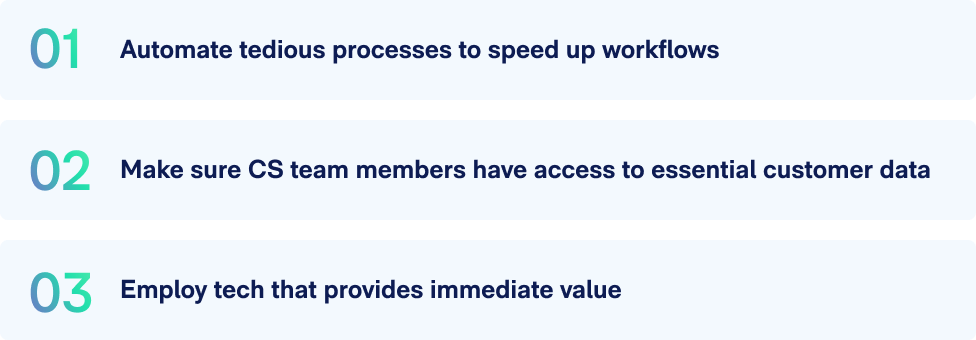
Scaling outreach programmatically will equip CSMs to take on additional accounts, build relationships, and drive revenue.
By following the tips outlined in this handbook, your company will be able to stay ahead of the competition when it comes to customer retention.

Retention can’t fall solely on the CS team — it takes a village to keep customers coming back year after year. Customer retention requires synergy and cooperation between the customer, CS team, product team, sales team, and executives so that customer feedback can be acted upon accordingly. Knowing this, your team needs to have a feedback loop established so you can proactively respond to the voice of the customer.
Sporadic meetings and emails with CSMs aren’t enough to make a customer feel valued. Customers who don’t feel important or that their needs are not being heard are more likely to take their business elsewhere. To make sure feedback can be turned into action, follow these best practices.
With a strong feedback loop in place, your team can work toward increasing retention rates and building trust with customers.
To make sure feedback can be turned into action, follow these best practices:
